NEWS
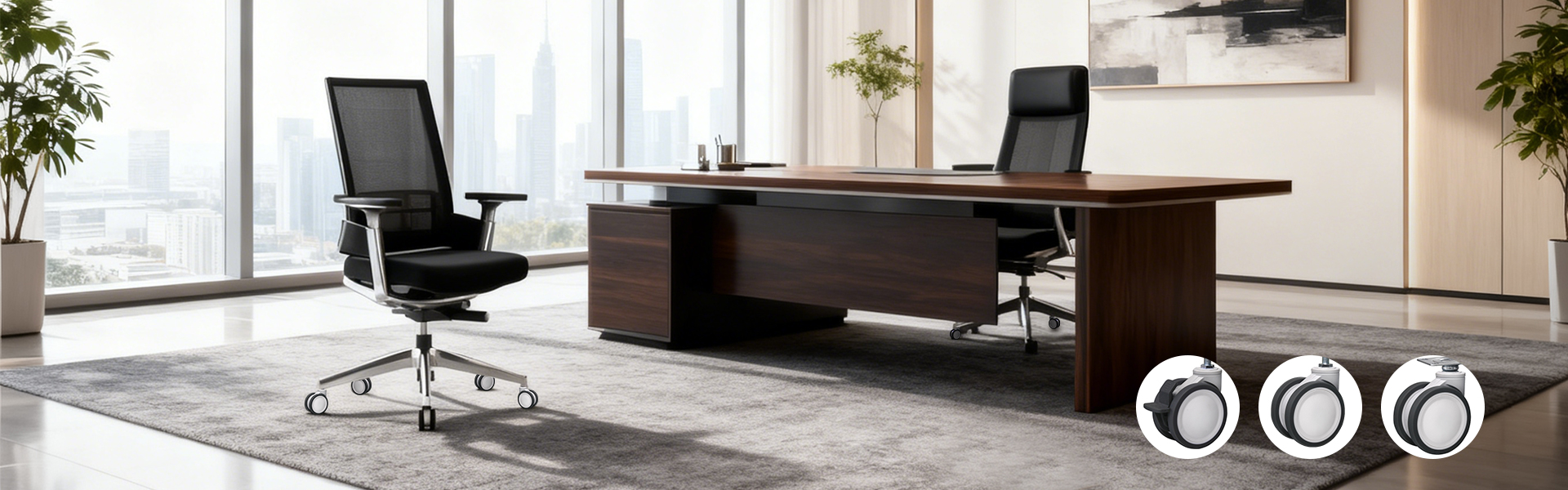
How to Choose the Right Caster Wheels: A Complete Guide to Types, Materials, and Load Capacity
2026-11-04
Caster wheels play an important role in making furniture, industrial equipment, medical devices, and material handling systems easier to move. Although they may look like simple components, choosing the right caster wheels can significantly affect equipment performance, mobility, stability, and service life.
With so many caster wheel types, materials, sizes, and mounting options available, how do you choose the most suitable solution for your application?
In this guide, Promove Caster, a professional caster manufacturer in China, will explain the key factors you should consider when selecting caster wheels.
1. Understand the Different Types of Caster Wheels
Before choosing caster wheels, it is important to understand their basic structures and functions.
Generally, caster wheels can be divided into three main types:
(1) Fixed Casters
Fixed casters, also known as rigid casters, move in a straight line and cannot rotate. They are commonly used in combination with swivel casters to provide stable and controlled movement.
Typical applications include:
*Industrial carts
*Warehouse trolleys
*Material handling equipment
*Heavy-duty storage racks
(2) Swivel Casters
Swivel casters feature a rotating mounting structure that allows the wheel to turn 360 degrees. This provides greater flexibility and makes equipment easier to maneuver in tight spaces.
They are widely used in:
*Office furniture
*Display racks
*Storage cabinets
*Medical equipment
*Commercial carts
(3) Swivel Casters with Brakes
Swivel casters with brakes allow users to stop and secure equipment when necessary. Depending on the design, the brake may lock the wheel, the swivel movement, or both.
They are particularly useful for:
*Hospital beds
*Medical carts
*Mobile workstations
*Equipment requiring stable positioning
Choosing the correct caster structure depends on whether your application requires straight-line movement, flexible maneuverability, or additional braking functions.

2. Choose the Right Caster Wheel Material
Wheel material is one of the most important factors affecting performance, durability, noise levels, and floor protection.
Different materials offer different advantages. Here are some commonly used caster wheel materials.

PP (Polypropylene) Caster Wheels
PP caster wheels are lightweight, economical, and suitable for general-purpose applications.
Key advantages:
(1)Cost-effective solution
(2) Good resistance to many common chemicals
(3) Lightweight construction
(4) Suitable for general furniture and storage applications
Typical applications: Furniture, office cabinets, display racks, and light-duty equipment.
PVC Caster Wheels
PVC caster wheels offer a balance between cost and basic wear resistance. They are suitable for various light-duty applications where economical mobility solutions are required.
Key advantages:
(1) Affordable material option
(2) Good wear resistance in suitable applications
(3) Available in different colors
(4) Suitable for general furniture and storage equipment
Typical applications: Storage cabinets, furniture, and light-duty carts.
TPR Caster Wheels
TPR (Thermoplastic Rubber) caster wheels are popular in applications where quiet operation and floor protection are important.
Key advantages:
(1) Quiet and smooth rolling
(2) Good shock absorption
(3) Non-marking performance in suitable formulations
(4) Helps protect indoor flooring
Typical applications: Office furniture, medical carts, furniture, and indoor equipment.
PU Caster Wheels
PU (Polyurethane) caster wheels are widely used in applications requiring good wear resistance and higher load-bearing performance.
Key advantages:
(1) Excellent abrasion resistance
(2) Good load-bearing performance
(3) Smooth rolling characteristics
(4) Good resistance to many oils and chemicals, depending on the formulation
Typical applications: Industrial equipment, warehouse carts, machinery, and material handling systems.
How should you choose?
For economical applications, PP and PVC may be suitable choices. For quieter operation and floor protection, TPR is worth considering. For applications requiring greater wear resistance and load-bearing performance, PU may be a better option.
The final selection should always consider the complete caster design, including wheel structure, core material, bearings, and operating conditions.
3. Understand Caster Wheel Load Capacity
Load capacity is another critical factor when selecting caster wheels.
Choosing casters with insufficient load capacity may cause premature wear, structural damage, or even equipment instability.
A simple method can help estimate the required load capacity.
Required load capacity per caster = (Equipment weight + Maximum load) / Number of load-bearing casters
For example:
Suppose a mobile cart weighs 40 kg and carries a maximum load of 160 kg.
The total weight is:
40 kg + 160 kg = 200 kg
If the cart uses four casters, a conservative calculation is to assume that only three casters share the load evenly:
200 kg / 3 = 66.7 kg
Therefore, each caster should have a rated load capacity of at least approximately 67 kg, subject to the manufacturer's test conditions and the actual operating environment.
Why use three casters instead of four in the calculation?
Because uneven floors, installation tolerances, and load distribution may prevent all four wheels from sharing the weight equally at every moment.
For applications involving frequent movement, impact, high speeds, or uneven surfaces, additional safety considerations are necessary.
Always check the manufacturer's rated load capacity and testing conditions before making a final selection.

4. Select the Appropriate Caster Mounting Type
Caster wheels are available with different mounting configurations. The two common options are plate mounting and threaded stem mounting.
Plate Mount Casters
Plate mount casters feature a flat metal mounting plate with bolt holes for installation.
Advantages:
(1) Secure attachment
(2) Suitable for various equipment structures
(3) Available in fixed and swivel configurations
(4) Suitable for applications requiring stable mounting
Typical applications: Industrial carts, machinery, medical equipment, and material handling equipment.
Threaded Stem Casters
Threaded stem casters use a threaded metal stem to connect the caster to equipment.
Common thread sizes include M6, M8, M10, and M12.
Advantages:
(1) Compact installation design
(2) Convenient for threaded mounting holes
(3) Suitable for furniture and certain equipment structures
(4) Available with different thread diameters and lengths
Typical applications: Office furniture, cabinets, chairs, and display racks.
Before ordering, always confirm the thread diameter, thread length, pitch, and mounting requirements to ensure proper installation.
5. Consider the Working Environment
The working environment also has a significant influence on caster wheel selection.
Different applications require different performance characteristics.
| Application | Recommended Considerations |
|---|---|
| Office furniture | Quiet rolling and floor protection |
| Storage cabinets | Compact design and economical materials |
| Warehouse carts | Load capacity and wear resistance |
| Industrial equipment | Durability and structural strength |
| Medical equipment | Smooth movement, braking, and noise control |
| Laboratory equipment | Mobility, stability, and application-specific chemical resistance |
For example, TPR wheels are often suitable for indoor environments where quiet operation is important, while PU wheels are commonly selected for industrial applications requiring better abrasion resistance.
The right solution depends on the actual floor conditions, operating frequency, load, and environmental requirements.
6. Why Quality and Manufacturing Experience Matter
Selecting the correct caster wheel is only part of the process. Product quality and manufacturing consistency are equally important.
When choosing a caster supplier, buyers should consider several factors:
-
Material Selection: Reliable raw materials help ensure consistent product performance.
-
Structural Design: Wheel cores, brackets, bearings, and mounting components all influence durability.
-
Quality Control: Appropriate inspection and testing procedures help maintain product consistency.
-
Customization Capability: Different applications may require specific dimensions, materials, colors, and mounting structures.
-
Technical Support: An experienced supplier should help customers identify suitable products based on their requirements.
Working with a manufacturer that understands different caster applications can help buyers reduce product selection risks and develop more competitive product ranges.
7. Promove Caster – Your Reliable Caster Wheel Manufacturer in China
At Zhongshan Promove Caster Co., Ltd., we specialize in the research, development, and manufacturing of caster wheels for different applications.
With our manufacturing experience, professional technical team, and integrated mold development capabilities, we provide caster solutions for customers across different industries and international markets.

Our main product categories include:
-
Customized Caster Solutions
We offer different wheel materials, including PP, PVC, TPR, and PU, with various sizes, mounting configurations, and functional options.
Whether you are sourcing standard caster wheels, developing a new product, or looking for an OEM manufacturing partner, our team can help you evaluate suitable solutions according to your requirements.
Our services include:
-
Product customization
-
Material and specification recommendations
-
OEM and private-label support
-
Mold development
-
Quality inspection
-
Professional technical assistance
We believe that reliable mobility solutions start with the right product design and consistent manufacturing quality.
Conclusion
Choosing the right caster wheels requires more than simply selecting a wheel diameter or load rating. You should consider the wheel material, mounting type, structure, working environment, and actual operating requirements.
A properly selected caster can improve equipment mobility, protect flooring, reduce noise, and extend product service life.
If you are looking for a reliable caster wheel manufacturer in China, Promove Caster is ready to support your sourcing and customization needs.
Contact Promove Caster today to discuss your caster wheel requirements and find the right solution for your business.
Website: https://www.promovecaster.com/
Email: enquiry@promovecaster.com
WhatsApp: +86 17724105224
Caster wheels play an important role in making furniture, industrial equipment, medical devices, and material handling systems easier to move. Although they may look like simple components, choosing the right caster wheels can significantly affect equipment performance, mobility, stability, and service life.
With so many caster wheel types, materials, sizes, and mounting options available, how do you choose the most suitable solution for your application?
In this guide, Promove Caster, a professional caster manufacturer in China, will explain the key factors you should consider when selecting caster wheels.
1. Understand the Different Types of Caster Wheels
Before choosing caster wheels, it is important to understand their basic structures and functions.
Generally, caster wheels can be divided into three main types:
(1) Fixed Casters
Fixed casters, also known as rigid casters, move in a straight line and cannot rotate. They are commonly used in combination with swivel casters to provide stable and controlled movement.
Typical applications include:
*Industrial carts
*Warehouse trolleys
*Material handling equipment
*Heavy-duty storage racks
(2) Swivel Casters
Swivel casters feature a rotating mounting structure that allows the wheel to turn 360 degrees. This provides greater flexibility and makes equipment easier to maneuver in tight spaces.
They are widely used in:
*Office furniture
*Display racks
*Storage cabinets
*Medical equipment
*Commercial carts
(3) Swivel Casters with Brakes
Swivel casters with brakes allow users to stop and secure equipment when necessary. Depending on the design, the brake may lock the wheel, the swivel movement, or both.
They are particularly useful for:
*Hospital beds
*Medical carts
*Mobile workstations
*Equipment requiring stable positioning
Choosing the correct caster structure depends on whether your application requires straight-line movement, flexible maneuverability, or additional braking functions.
2. Choose the Right Caster Wheel Material
Wheel material is one of the most important factors affecting performance, durability, noise levels, and floor protection.
Different materials offer different advantages. Here are some commonly used caster wheel materials.
PP (Polypropylene) Caster Wheels
PP caster wheels are lightweight, economical, and suitable for general-purpose applications.
Key advantages:
(1)Cost-effective solution
(2) Good resistance to many common chemicals
(3) Lightweight construction
(4) Suitable for general furniture and storage applications
Typical applications: Furniture, office cabinets, display racks, and light-duty equipment.
PVC Caster Wheels
PVC caster wheels offer a balance between cost and basic wear resistance. They are suitable for various light-duty applications where economical mobility solutions are required.
Key advantages:
(1) Affordable material option
(2) Good wear resistance in suitable applications
(3) Available in different colors
(4) Suitable for general furniture and storage equipment
Typical applications: Storage cabinets, furniture, and light-duty carts.
TPR Caster Wheels
TPR (Thermoplastic Rubber) caster wheels are popular in applications where quiet operation and floor protection are important.
Key advantages:
(1) Quiet and smooth rolling
(2) Good shock absorption
(3) Non-marking performance in suitable formulations
(4) Helps protect indoor flooring
Typical applications: Office furniture, medical carts, furniture, and indoor equipment.
PU Caster Wheels
PU (Polyurethane) caster wheels are widely used in applications requiring good wear resistance and higher load-bearing performance.
Key advantages:
(1) Excellent abrasion resistance
(2) Good load-bearing performance
(3) Smooth rolling characteristics
(4) Good resistance to many oils and chemicals, depending on the formulation
Typical applications: Industrial equipment, warehouse carts, machinery, and material handling systems.
How should you choose?
For economical applications, PP and PVC may be suitable choices. For quieter operation and floor protection, TPR is worth considering. For applications requiring greater wear resistance and load-bearing performance, PU may be a better option.
The final selection should always consider the complete caster design, including wheel structure, core material, bearings, and operating conditions.
3. Understand Caster Wheel Load Capacity
Load capacity is another critical factor when selecting caster wheels.
Choosing casters with insufficient load capacity may cause premature wear, structural damage, or even equipment instability.
A simple method can help estimate the required load capacity.
Required load capacity per caster = (Equipment weight + Maximum load) / Number of load-bearing casters
For example:
Suppose a mobile cart weighs 40 kg and carries a maximum load of 160 kg.
The total weight is:
40 kg + 160 kg = 200 kg
If the cart uses four casters, a conservative calculation is to assume that only three casters share the load evenly:
200 kg / 3 = 66.7 kg
Therefore, each caster should have a rated load capacity of at least approximately 67 kg, subject to the manufacturer's test conditions and the actual operating environment.
Why use three casters instead of four in the calculation?
Because uneven floors, installation tolerances, and load distribution may prevent all four wheels from sharing the weight equally at every moment.
For applications involving frequent movement, impact, high speeds, or uneven surfaces, additional safety considerations are necessary.
Always check the manufacturer's rated load capacity and testing conditions before making a final selection.
4. Select the Appropriate Caster Mounting Type
Caster wheels are available with different mounting configurations. The two common options are plate mounting and threaded stem mounting.
Plate Mount Casters
Plate mount casters feature a flat metal mounting plate with bolt holes for installation.
Advantages:
(1) Secure attachment
(2) Suitable for various equipment structures
(3) Available in fixed and swivel configurations
(4) Suitable for applications requiring stable mounting
Typical applications: Industrial carts, machinery, medical equipment, and material handling equipment.
Threaded Stem Casters
Threaded stem casters use a threaded metal stem to connect the caster to equipment.
Common thread sizes include M6, M8, M10, and M12.
Advantages:
(1) Compact installation design
(2) Convenient for threaded mounting holes
(3) Suitable for furniture and certain equipment structures
(4) Available with different thread diameters and lengths
Typical applications: Office furniture, cabinets, chairs, and display racks.
Before ordering, always confirm the thread diameter, thread length, pitch, and mounting requirements to ensure proper installation.
5. Consider the Working Environment
The working environment also has a significant influence on caster wheel selection.
Different applications require different performance characteristics.
| Application | Recommended Considerations |
|---|---|
| Office furniture | Quiet rolling and floor protection |
| Storage cabinets | Compact design and economical materials |
| Warehouse carts | Load capacity and wear resistance |
| Industrial equipment | Durability and structural strength |
| Medical equipment | Smooth movement, braking, and noise control |
| Laboratory equipment | Mobility, stability, and application-specific chemical resistance |
For example, TPR wheels are often suitable for indoor environments where quiet operation is important, while PU wheels are commonly selected for industrial applications requiring better abrasion resistance.
The right solution depends on the actual floor conditions, operating frequency, load, and environmental requirements.
6. Why Quality and Manufacturing Experience Matter
Selecting the correct caster wheel is only part of the process. Product quality and manufacturing consistency are equally important.
When choosing a caster supplier, buyers should consider several factors:
-
Material Selection: Reliable raw materials help ensure consistent product performance.
-
Structural Design: Wheel cores, brackets, bearings, and mounting components all influence durability.
-
Quality Control: Appropriate inspection and testing procedures help maintain product consistency.
-
Customization Capability: Different applications may require specific dimensions, materials, colors, and mounting structures.
-
Technical Support: An experienced supplier should help customers identify suitable products based on their requirements.
Working with a manufacturer that understands different caster applications can help buyers reduce product selection risks and develop more competitive product ranges.
7. Promove Caster – Your Reliable Caster Wheel Manufacturer in China
At Zhongshan Promove Caster Co., Ltd., we specialize in the research, development, and manufacturing of caster wheels for different applications.
With our manufacturing experience, professional technical team, and integrated mold development capabilities, we provide caster solutions for customers across different industries and international markets.
Our main product categories include:
-
Customized Caster Solutions
We offer different wheel materials, including PP, PVC, TPR, and PU, with various sizes, mounting configurations, and functional options.
Whether you are sourcing standard caster wheels, developing a new product, or looking for an OEM manufacturing partner, our team can help you evaluate suitable solutions according to your requirements.
Our services include:
-
Product customization
-
Material and specification recommendations
-
OEM and private-label support
-
Mold development
-
Quality inspection
-
Professional technical assistance
We believe that reliable mobility solutions start with the right product design and consistent manufacturing quality.
Conclusion
Choosing the right caster wheels requires more than simply selecting a wheel diameter or load rating. You should consider the wheel material, mounting type, structure, working environment, and actual operating requirements.
A properly selected caster can improve equipment mobility, protect flooring, reduce noise, and extend product service life.
If you are looking for a reliable caster wheel manufacturer in China, Promove Caster is ready to support your sourcing and customization needs.
Contact Promove Caster today to discuss your caster wheel requirements and find the right solution for your business.
Website: https://www.promovecaster.com/
Email: enquiry@promovecaster.com
WhatsApp: +86 17724105224

Contact Info
Email: enquiry@promovecaster.com
Tel: +86 17724105224
WhatsApp: +86 17724105224
Address: Yonglong Road, JiDongYi, Xiaolan Town, Zhongshan City, Guangdong Province, China
Copyright © 2025 Zhongshan Promove Caster Co., Ltd.